Deterministic detection
Uses runtime globals, script URLs, stylesheet links, and framework metadata to reduce false positives.
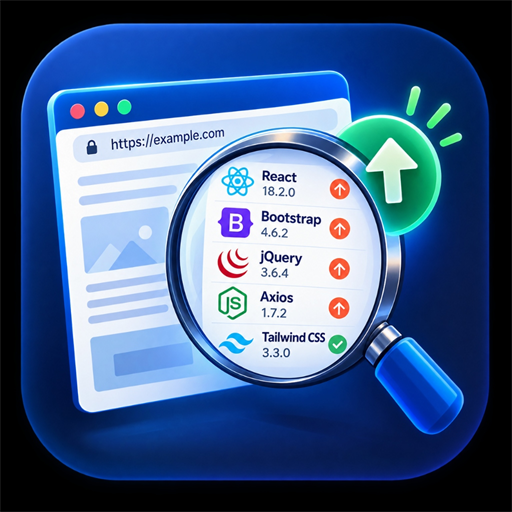 Website Upgrade Detector
Website Upgrade Detector scans the active webpage for supported JavaScript and CSS libraries, identifies the versions exposed by the page, and checks npm for the latest published versions.
The MVP stays focused: detect what is exposed by the page, compare it with current npm releases, and explain the result without pretending that an upgrade is mandatory.
Uses runtime globals, script URLs, stylesheet links, and framework metadata to reduce false positives.
Checks the public npm registry for the latest published package version instead of relying on a manually maintained list.
Compares numeric major, minor, patch, and pre-release versions correctly.
Distinguishes major-version changes from regular updates so the impact is clearer.
Website details stay in the browser. npm receives only the package name needed for version lookup.
If a version is unknown or npm is unreachable, the detector reports that state instead of guessing.
This static demo illustrates the extension's result states. The real Edge extension performs detection on the current webpage.
| Library | Detected | Latest published | Status |
|---|
Website Upgrade Detector is designed as a client-side developer utility. It does not require an account or backend service.
The extension does not transmit webpage URLs, DOM content, browsing history, cookies, credentials, or telemetry. For npm version checks, only the public package name is requested from the npm registry.
Found a bug or a library that should be supported? Open an issue on GitHub with the extension version, Edge version, and steps to reproduce.